
DIII-D Ombuds Resource
Independent. Impartial. Informal. Confidential.
If you’d like support with any DIII-D related issue, the ombuds team is here for you.
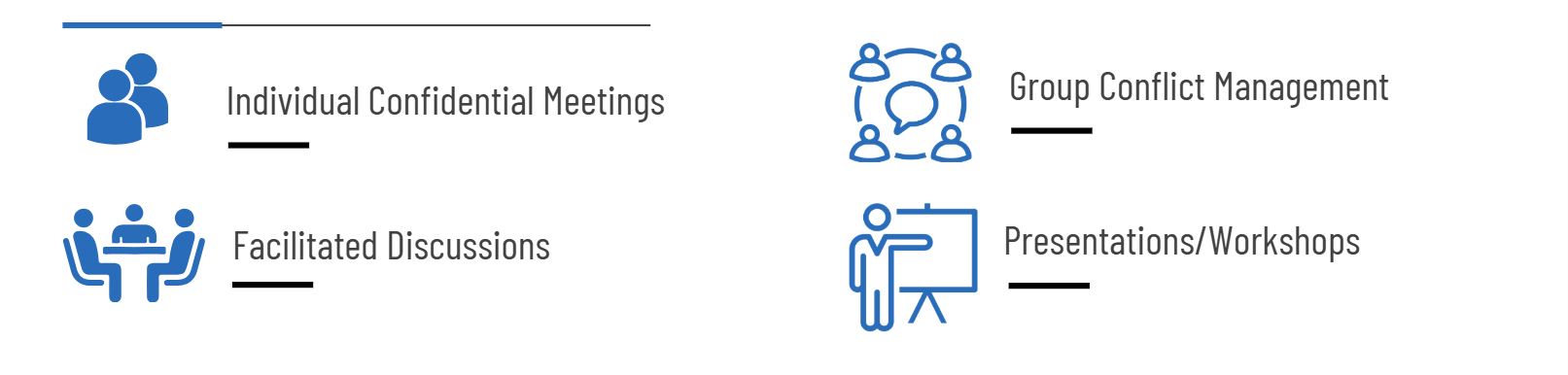
We can help with any DIII-D related issue, including:
|
|

If you’d like support with any DIII-D related issue, the ombuds team is here for you.
We can help with any DIII-D related issue, including:
|
|
In a confidential, off-the-record meeting, we will listen, explore different options for addressing your concerns, help you navigate relevant organizational resources, and coach you through how to effectively communicate your concerns to others should you choose to do so. We can also help facilitate informal discussions between two or more people when appropriate or work with groups experiencing conflict.
The term “ombuds” (pronounced “ahm–buhds”) comes from a Swedish term meaning “a person who has an ear to the people.” The ombuds team is an independent, impartial, informal, and confidential resource for DIII-D team members, including users and GA employees working within DIII-D.
An ombuds can help you brainstorm and evaluate options to address your concern(s) or questions, prepare for a difficult conversation, navigate complex organizational dynamics, identify relevant policies and procedures, determine how to raise a concern effectively, proactively prevent conflict, and anonymously raise concerns to leadership.
The DIII-D ombuds team has two ombuds, Alnoor Maherali and Lexi Wolfe (see bios below), who are available to work with DIII-D team members to effectively manage, address effectively, and surface work-related issues. The ombuds team supplements and does not replace formal administrative channels.
Please see this page for answers to Frequently Asked Questions (FAQs) about the ombuds resource.
This page offers a curated collection of tools and resources to help you effectively manage challenging situations and resolve conflicts in the workplace.
For a conflict-resolution tip from your DIII-D ombuds team check out these articles:
Avoidance is a common reaction to conflict – this article articulates the importance of addressing conflict as it arises.
We all can fall into the trap of jumping to conclusion in interpersonal interactions, this article details why so many of us make assumptions and how to interpret the tendency to jump to conclusions.
Contact one of the ombuds below to discuss your concerns and explore options to move forward.
 Alnoor Maherali (alnoor-ombuds@mwi.org and 848-456-8080) is a highly-skilled ombuds, mediator, trainer, and consultant with MWI. He offers 20 years of experience working in conflict zones, in the not-for-profit sector, and as a practitioner in the fields of diplomacy, mediation, human rights, and crisis management. His personal and professional travels have taken him to over 50 different countries, making him especially adept at navigating cultural, ethnic, and racial conflicts and differences. Alnoor resides in New York City and mediates for MWI, Venn Mediation, the Office of the United Nations Ombudsman and Mediation Services (UNOMS), and the New York Peace Institute (NYPI). He coaches and mentors the next generation of mediators at Harvard, Yale, and The Fletcher School of Law and Diplomacy. Alnoor also provides training and coaching on negotiation, collaboration, and difficult conversations through MWI and Vantage Partners. His professional accomplishments include the negotiation of resolutions at the United Nations in Geneva and New York, the sharing of best practices in disaster response and civil-military coordination with the Government of Brazil, and important roles in the resolution of two high-profile kidnapping cases in Afghanistan. Additionally, he has demonstrated a strong commitment to the community, volunteering with Hospice Care Ottawa for 12 years and serving on their Board of Directors for four. Alnoor has a Bachelor of Science (Honors) in Mathematics from Queen’s University in Canada and a Master’s in Public Administration from the Harvard Kennedy School in the US. He was trained by the International Ombuds Association in the Foundations of Organizational Ombuds Practice course. Schedule a time to talk with Alnoor by sending an email to alnoor-ombuds@mwi.org, calling 848-456-8080, or texting 848-456-8080.
 Lexi Wolfe (lexi-ombuds@mwi.org and 828-419-0082) is an organizational ombuds and conflict resolution practitioner who supports mission-driven organizations through informal conflict resolution, coaching, facilitation, and training, with a focus on research and scientific environments. She supports leaders, teams, and individuals in navigating difficult situations at work with clarity, confidence, and practical next steps. Most recently, Lexi served as Acting Director of the U.S. Department of Energy Office of the Ombudsman after serving as an Associate Ombudsman (2019–2025). She previously served as an Ombudsman Specialist at the Transportation Security Administration and helped launch and manage the U.S. Small Business Administration’s Conflict Resolution Center. Lexi holds an M.S. in Negotiation & Conflict Resolution from Columbia University. She is a Certified Organizational Ombuds Practitioner (CO-OP®) through the International Ombuds Association and an Associate Certified Coach (ACC) through the International Coaching Federation (ICF). Schedule a time to talk with Lexi by sending an email to lexi-ombuds@mwi.org or by calling or texting 828-419-0082.
An ombuds team member will get back to you within one business day.
The ombuds resource was established under a charter approved by the DIII-D Director, Richard Buttery. A copy of that charter can be found here. The charter incorporates by reference the Code of Ethics and Standards of Practice of the International Ombuds Association (IOA) and requires that the DIII-D Ombuds Resource adhere to the IOA Code of Ethics and Standards of Practice. The charter, as well as the IOA Code of Ethics and Standards of Practice, contain important information about the DIII-D Ombuds Resource and the manner in which it functions.
Due to the independent, impartial, informal, and confidential nature of the ombuds function, communication with an ombuds team member does not constitute formal notice to DIII-D.